Introducing Frontwise Weekly: Tracking AI in Practice Across Global Finance
A weekly view of how financial institutions are putting AI to work, with a focus on Asia.

Based in Hong Kong. Serving Asia.
Frontwise Weekly launches its inaugural issue on 2 October 2026.
1. Beyond model selection, the industry needs a shared frame of reference
When financial institutions discuss AI adoption, the conversation often starts with a familiar question: which model should we use?
Among the investment teams we work closely with in Hong Kong and overseas, almost every institution is already building its own AI workflows. Model selection is becoming one decision among many:
- Some start with institutional knowledge: turning years of internal research into a searchable library with citations and version history.
- Some start with connected data: bringing market data, internal deal records and partners’ notes into one assistant to answer questions across systems.
- Some start with workflow redesign: breaking research into individual steps before deciding which tasks to assign to an agent.
The approaches differ, but a common difficulty remains: it is hard to see how peers are actually working, or to find a useful benchmark for your own progress.
Institutions need answers to three questions:
- Which parts of the investment research process are worth redesigning with AI?
- Which applications are delivering tangible business value?
- Which remain demonstrations or proofs of concept?
There is no shortage of published case studies. What is often missing is enough detail to judge the business problem being solved, whether a tool can safely fit into an existing workflow, and whether the benefits justify the cost.
Different roles need that information for different decisions. Investment leaders want to know whether AI improves research quality and decision-making efficiency. Senior management needs evidence to allocate budgets and resources. CTOs and product leaders must translate business needs into tools that can be deployed and used over time.
That is why we are launching Frontwise Weekly: to track AI in financial services and explain who is using it, where it fits into the workflow, what results have been reported, and what it takes to make it work.
We want to give the industry a shared frame of reference.
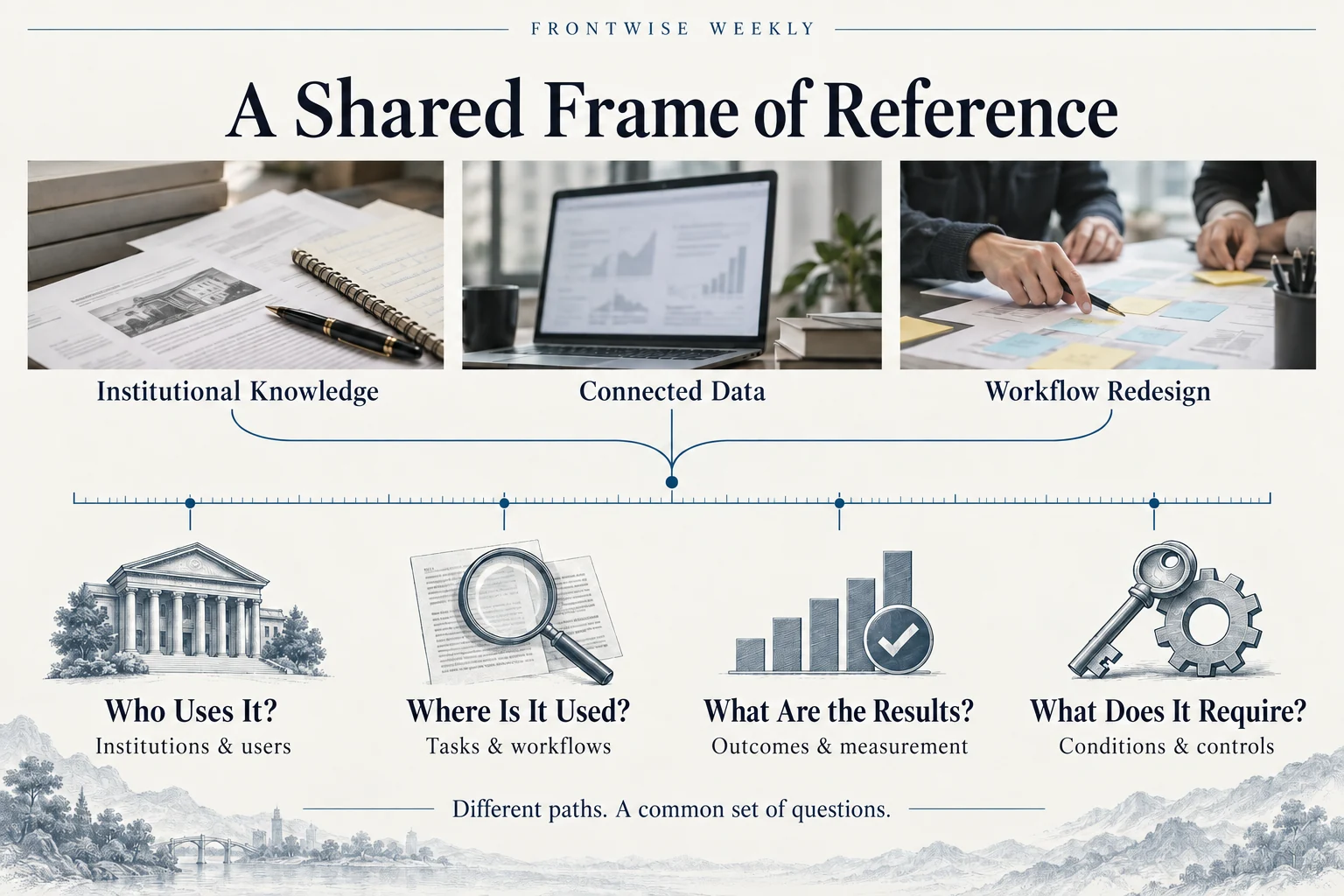
Figure 1. Different paths, assessed through a common set of questions.
2. Why we are taking on this work
Our team brings more than a decade of experience in financial and investment research.
That experience helps us understand the business questions investment leaders face, as well as the compliance, data and working-practice constraints a tool must address before it becomes part of everyday research.
Two things underpin our commitment to this publication.
A business perspective
Frontwise helps investment institutions in Hong Kong and across Asia put AI to work in research and data workflows. We provide AI advisory, training and embedded implementation support through Forward Deployed Engineering (FDE).
For every case, we ask: What problem does it solve? What needs to be in place first? What can another institution learn from it?
Experience of implementation
Our project work exposes us to both the capabilities of these tools and the costs and constraints of implementation. Our editorial approach follows the same discipline:
We distinguish what we have tested ourselves from what others have reported, and make clear what remains uncertain.
Investment teams need to spend their time on research and decisions. Following global practice, filtering information and checking reported results takes sustained effort.
We are willing to do that work. It is also part of doing our own work well.
3. Building an Asia-focused counterpart to AI Street
AI Street is a newsletter following how Wall Street puts advanced language models to work, covering hedge funds, asset managers, banks, fintech companies and regulators.
It helped inspire Frontwise Weekly: a weekly publication tracking AI practice across global financial institutions, with a particular focus on what matters to institutions in Asia. We select cases and industry developments that clarify the business use case, reported outcomes and conditions for adoption.
Each issue follows three editorial principles:
- Evidence readers can check. We focus on institutional practice, identify sources and explain the scope of reported figures.
- A clear distinction between reporting and analysis. Each case has two layers: Facts and Frontwise View. Frontwise View contains What It Means and Where to Start, covering our interpretation and practical next steps.
- Editorial independence. We do not rank institutions, recommend products or accept commercial arrangements that make coverage a condition. Our content is not investment advice.
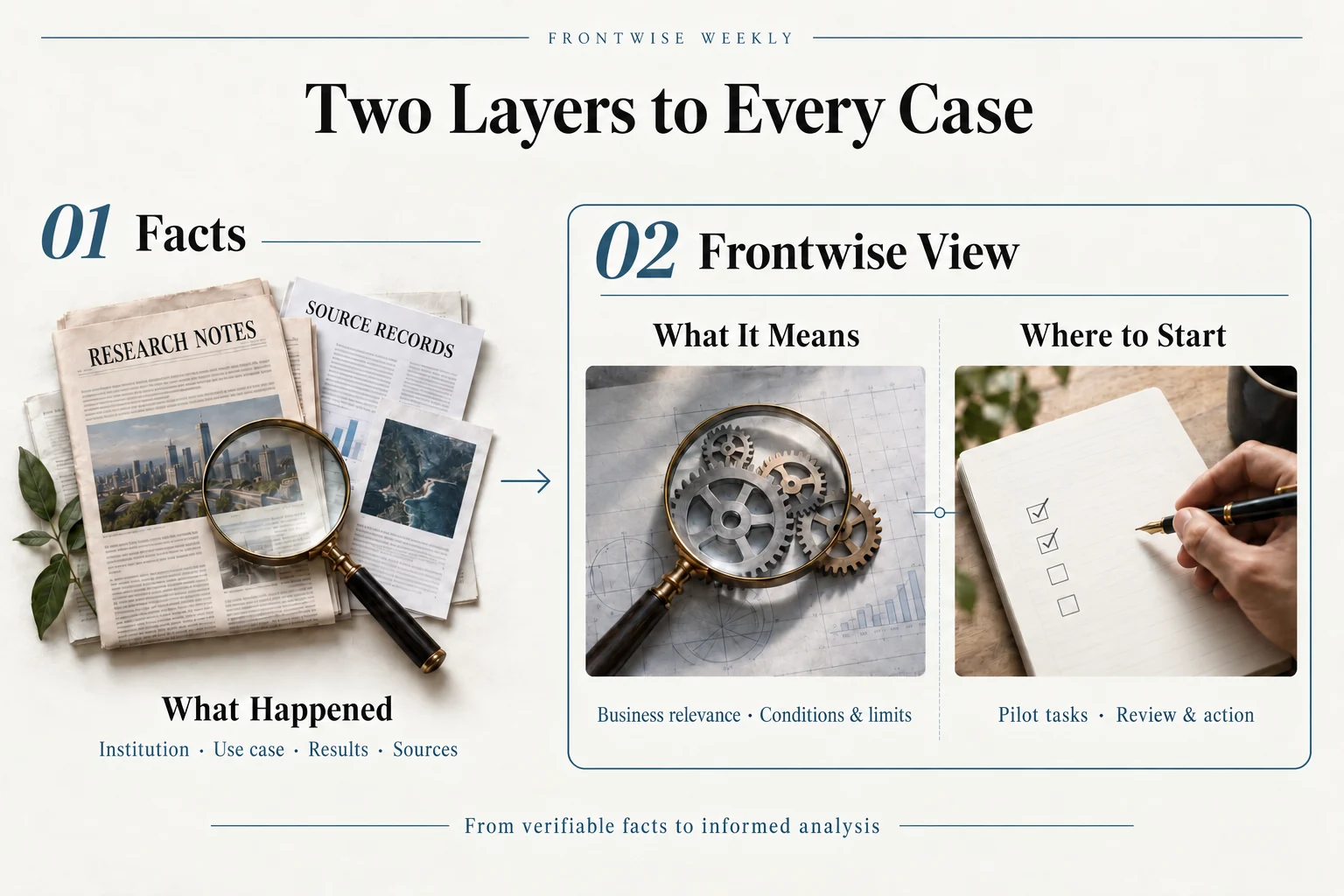
Figure 2. Two layers to every case: Facts, followed by Frontwise View. Interpretation and practical next steps both sit within our analysis.
The publication’s value should become clearer through continued reading. Three months from now, we hope readers will be better equipped to decide which applications deserve further work and which assumptions need revisiting.
4. Inside the inaugural issue: four editorial sections
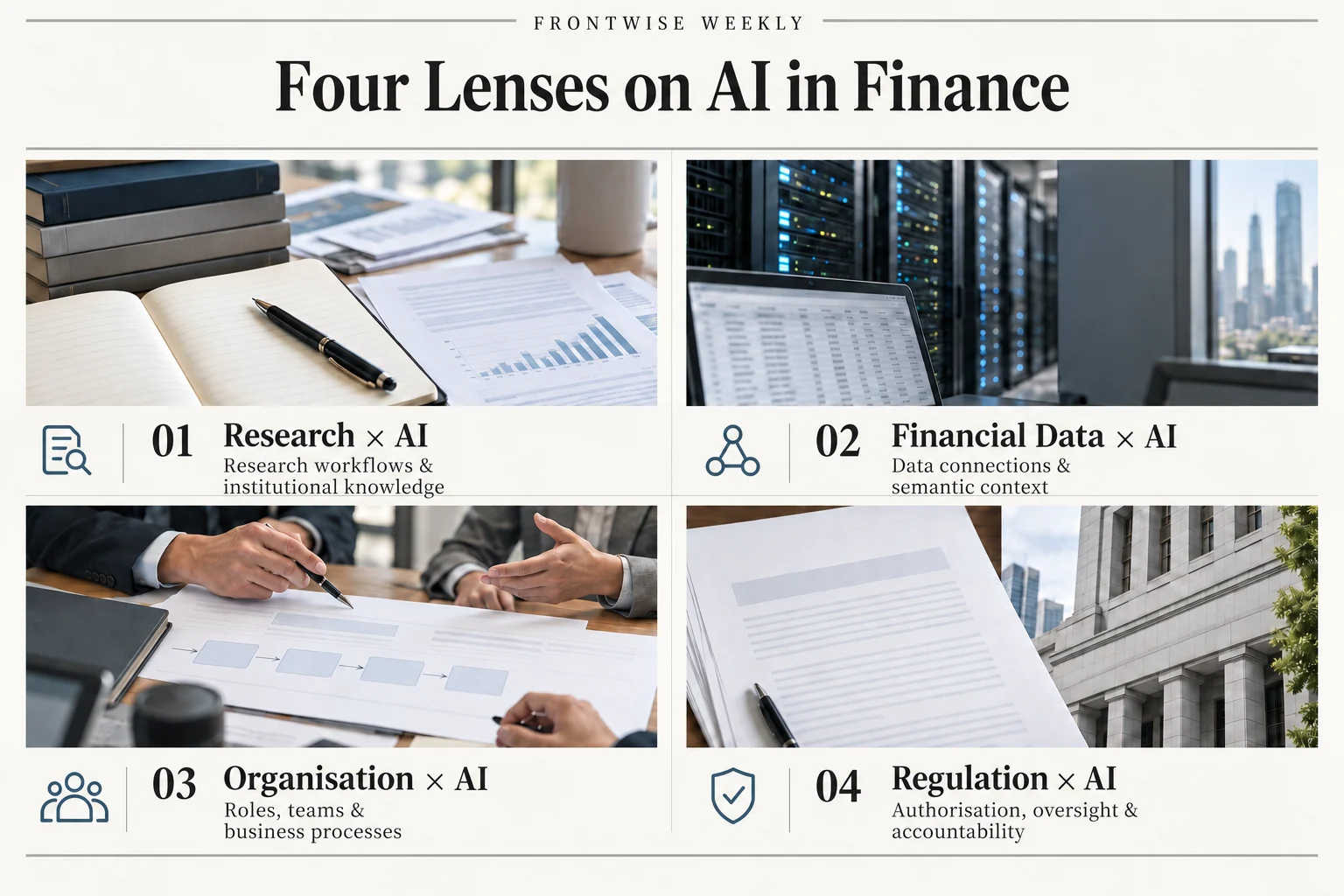
Figure 3. The inaugural issue covers Research × AI, Financial Data × AI, Organisation × AI and Regulation × AI.
The inaugural issue is titled “Seven Firms Putting AI into the Research Workflow”. The following selections illustrate its four editorial sections.
Read Frontwise Weekly, Issue 001
Research × AI
Millennium: personal AI assistants inside everyday workflows
Hedge fund · September 2026
Facts
Millennium reports that its Digital Twin programme is available to all employees who wish to use it, supporting research, monitoring and preparation of materials. More than 1,600 digital twins are in use. In the initial pilot of more than 150 people, 97% interacted with their assistant daily.
Each digital twin has its own identity and audit trail. Employees grant access system by system, as needed, within their existing permissions.
Frontwise View
What It Means
The case is instructive at the level of organisational design. Giving an AI assistant its own identity, a defined person to support and explicit access boundaries creates a basis for rethinking task delegation, review and accountability.
Where to Start
Choose one frequent, clearly bounded task for a small pilot. Define permissions, audit records and responsibility for human review from day one.
Source: Millennium’s official Digital Twins interview; full link below.
Ardian: turning 30 years of institutional knowledge into diligence and drafting support
Private equity · 14 September 2026
Facts
Ardian’s Buyout team organised historical deal materials into a knowledge layer with citations and version records. According to implementation partner JAKALA, the covered drafting tasks took more than 70% less time, drawing on roughly 30 years of deal experience. The team is also testing specialist agents working on research in parallel and mechanisms for debating opposing views.
The reported reduction concerns specific drafting tasks. It should not be read as a measure of overall research quality or investment performance.
Frontwise View
What It Means
The useful lesson is the conversion of historical documents into a searchable, citable institutional asset. That foundation determines whether later applications can draw reliably on the firm’s accumulated experience.
Where to Start
Check whether core research materials have clear source, version and citation records before deciding which AI applications to connect to them.
Source: JAKALA’s project case study; full link below.
Scale Venture Partners: connecting external data with institutional deal memory
Venture capital · 20 September 2026
Facts
Scale Venture Partners built its own Model Context Protocol (MCP) server to connect PitchBook, deal records in Salesforce and partners’ notes to a research assistant.
One question was specific: among a company’s co-investors, which had previously led deals that the firm had passed on? The firm reports that this cross-system query fell from around 30 minutes to under one minute.
Frontwise View
What It Means
The tool’s scope is defined by an actual research question. It also retains authentication for each request, per-user rate limits and tool-call logs. Those implementation details are useful reference points for investment teams.
Where to Start
Pick a recurring question that requires information from at least two systems. Use it as the first pilot, then expand data access as the work requires.
Source: Scale Venture Partners’ account of its internal implementation; full link below.
Financial Data × AI
Bloomberg: giving financial data the context AI needs to interpret it
29 September 2026 · Industry development
Facts
Bloomberg announced Enterprise MCP for Data License Plus, a standardised AI access layer covering more than 100 million securities and over 50,000 fields.
Alongside entitled data, it supplies information such as field definitions, calculation methods, currencies, price types and data timestamps.
Frontwise View
What It Means
A central difficulty in giving financial data to AI is whether the model can interpret a number correctly after retrieving it. A “price” may refer to different exchanges, currencies or points in time.
Providing data together with its context helps an agent assess whether it is suitable for the task.
Where to Start
When evaluating a data interface, look beyond coverage. Ask: does it return field definitions and the relevant data timestamps?
Source: Bloomberg’s announcement via PR Newswire; full link below.
Organisation × AI
DBS Hong Kong: bringing business banking tasks into the conversation
Phased rollout from 26 September 2026
Facts
DBS Joy began a phased introduction of agent capabilities on 26 September. Business customers can check payment status, transactions and fees within a conversation, without navigating across pages. The service requires customers to be logged in and to initiate the interaction, and retains access to human support.
Frontwise View
What It Means
As an assistant connects to business operations, identity verification, the scope of tools it can call and routes to human support become part of the service design.
Where to Start
Assess both the operations an assistant can perform and when—and how—it hands over to a person.
Source: DBS’s official announcement; full link below.
Regulation × AI
Hong Kong Monetary Authority: delegating to agents does not transfer management accountability
25 September 2026
Facts
In presentation materials for the Hong Kong Institute of Bankers’ annual conference, Arthur Yuen distinguished four AI roles: assisting, recommending, deciding and acting. He emphasised that boards and senior management remain accountable for the full action path, including authorisation boundaries, approval and escalation, traceability and challenge, and human intervention.
Frontwise View
What It Means
The message is that governance must cover the full workflow as AI gains the ability to act.
Where to Start
For each agent workflow, identify who grants authority, where approval is required, how issues escalate and how people can intervene. Assess the design against the regulatory requirements applicable to the institution.
Source: HKMA presentation materials, pages 5–7; full link below.
Frontwise Weekly publishes every week, with consistent sections, reporting criteria and coverage windows.
Follow the publication
Visit frontwise.ai for new issues every Friday. Readers on WeChat can also follow our official account, 锋睿AI, for publication updates.
Help shape what we investigate next
If this publication is useful to your investment colleagues, please share it with them. We would also like to hear from people doing this work inside institutions.
Which part of your investment research workflow most needs improvement—and where is AI proving hardest to put into practice?
Send a message to our WeChat account or contact Amy Xiao on WeChat: amy709545. Your questions will help inform what we follow up and investigate in future issues.
Sources
- Millennium: Official Digital Twins interview.
- Ardian / JAKALA: Implementation case study.
- Scale Venture Partners: Building an MCP server for investment research.
- Bloomberg: Enterprise MCP announcement.
- DBS: Hong Kong AI assistants announcement.
- HKMA: Arthur Yuen’s presentation, pages 5–7.
Frontwise | Your Strategic Partner for AI Transformation in Finance
Advisory · Training · Forward Deployed Engineering
This publication draws on the public sources listed above. Performance figures and product capabilities are reported by the relevant institutions or project partners and have not been independently tested by Frontwise. “Frontwise View” is editorial analysis. Earlier cases may be included to provide context. Nothing in this publication constitutes investment advice.